Trying to turn Afghanistan into a democracy failed where a monarchy might have succeeded. In Iran, will exiled Prince Pahlavi return to rule?
As the war in Iran drags on, there have been constant reminders of why the Iranian regime had to go.
“The Enemy in Iran in One Lesson,” fumed the editorial board of the Wall Street Journal on March 19, 2026. “The regime resumes hanging protestors, including a national team wrestler.”
“We know it’s fashionable on the left and even in some parts of the right these days to think that President Trump is the enemy in the Iran war,” sniffed the WSJ. “So forgive us for pointing out the character of the actual enemy our troops are fighting. To wit, Iran’s regime has resumed executing its citizens for protesting against the government.”
“The hangings underscore the brutal way the regime has tried to stop the protests,” the WSJ added. “By some counts, regime enforcers killed as many as 32,000 Iranians who took to the streets. Photographs leaked from the country show body bags lined up en masse. Many of the wounded were pursued and then killed in hospitals.”
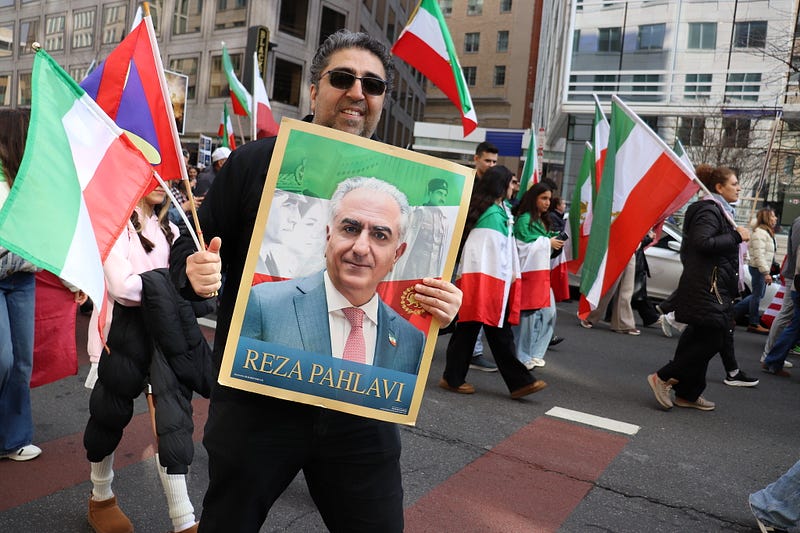
For his part, Prince Reza Pahlavi has been expressing equal parts outrage and hope while watching the throes of a dying regime: Outrage at the crushing misery heaped upon the Iranian people by a tyrannical government that is down but not out; hope that this might be the moment for Iranians to seize their freedom.
“My compatriots, Today, we usher in our new year amidst a patriotic battle against the un-Iranian Islamic Republic, in memory of all the brave and immortal sons and daughters of Iran,” wrote exiled Iranian prince Reza Pahlavi on social media this week. “The year that passed was a year of organizing for the final action; a year of the splendor of national solidarity, unparalleled acts of courage, and great sacrifices; a year that brought us one giant step closer to ultimate victory; a year that demonstrated the Iranian nation’s resolve to build a free and prosperous future is firmer than ever before.”
“In the year that passed, the Zahhak of our time was slain, and his guardians have yet to bury him in the earth,” wrote the Prince. “In the year ahead, we shall together bury this Zahhak-like regime in the earth forever. Our Iran, in the past year, lost tens of thousands of its finest sons and daughters in the battle against this Zahhak-like regime. We send our salutations to their pure souls, we stand alongside their families, and with those valiant lives, and with one another, we pledge to transform this new year into the year of victory for the Lion-and-Sun Revolution of Iran.”
“In these opening moments of the year, we brighten our hearts, strengthen our unity, and advance toward a free and prosperous Iran with even firmer steps,” he promised. “May your Nowruz be victorious! Long live Iran!”
It is time for the prince to return to Iran?
While it’s true that monarchy isn’t something the U.S. embraces, the same can’t be said for everywhere else on earth.
Afghanistan taught a brutal lesson: legitimacy matters more than Washington’s preferences. If Iran gets a post-Islamic Republic future, the real question is not whether monarchy sounds old-fashioned. It is whether it might fit better than another imported political fantasy.
One of the great unlearned lessons of the last quarter century is that Americans keep confusing our favorite form of government with the only legitimate form of government.
We did it in Afghanistan. We told ourselves a story about ballots, constitutions, ministries, women’s programs, development contracts, and national elections. We called that democracy.
It was a democracy on paper. Then it collapsed like stage scenery.
SIGAR’s own postmortem could not have been much clearer: the United States failed to build stable democratic institutions in Afghanistan, and one of the reasons was that the whole system was too centralized, too corrupt, too Kabul-centric, and too detached from how legitimacy actually functioned in Afghan life. The Bonn process concentrated power in the presidency and raised the stakes of every political fight. Elections were fraud-marred. Turnout cratered. The state never really earned the trust it needed.
Washington was arrogant. We acted as though legitimacy could be air-dropped in shrink-wrap. We preferred a system that looked familiar to us over one that might actually have fit the country we were claiming to save.
Afghanistan under King Mohammad Zahir Shah had, however imperfectly, experimented with constitutional monarchy. The 1964 constitution created elected bodies and limited the royal family’s direct grip on office. Zahir Shah’s long reign is still remembered as one of the more stable periods in modern Afghan history.
And here is the part Americans still do not like to say out loud: a monarchy might actually have worked better there.
In 2002, many delegates at the Loya Jirga reportedly wanted Zahir Shah to lead the country, not because Afghans were yearning for feudal romance, but because the old king represented something rare in Afghanistan: a symbol above faction. Reporting at the time said hundreds of delegates petitioned for him and that U.S. envoy Zalmay Khalilzad pushed hard to block that outcome in favor of Hamid Karzai. Zahir Shah ultimately renounced a political role.
Maybe monarchy would still have failed. Maybe the Taliban, Pakistan, corruption, and the rest would still have overwhelmed it. But it is no longer crazy to say that a constitutional monarchy might have had a better chance than the brittle republic we built and then abandoned.
Which brings us to Iran.
As the Islamic Republic enters another week under severe strain, the question of Reza Pahlavi no longer feels like pure exile nostalgia. He has become a prominent opposition voice again and is explicitly presenting himself as ready to help lead a transition.
His actual support inside Iran is difficult to measure, however. He has admirers. He has detractors. He has symbolism. Whether he has enough real political ballast is another matter.
Still, the interesting thing about Pahlavi is that he is not publicly selling a simple restoration fantasy. He has repeatedly argued for a secular, democratic Iran and said the Iranian people should decide the final form of government through a constitutional process.
On his own website this year, Mr. Pahlavi described the people’s right to choose a democratic form of government as a core principle and said a constitutional process should follow any transition. In other words, even the prince seems to understand that in 2026 you do not just stride back into Tehran, dust off the throne, and announce that history has been reversed.
And that is wise, because the Pahlavi name carries baggage as well as glamour.
Mohammad Reza Shah was not overthrown because Iranians were irrationally allergic to modernity. He was overthrown because his regime became increasingly repressive, because political participation narrowed, because the White Revolution disrupted traditional society while distributing its gains unevenly, and because the monarchy’s association with the 1953 CIA- and MI6-backed coup never really left Iranian political memory.
Any son returning under foreign auspices would be walking straight into that history.
Maybe “Will Reza Pahlavi return to his father’s throne?” is the wrong question. His father’s throne is not the point. The point is whether a prince could function as a transitional symbol, or even later as a constitutional monarch, in a country exhausted by ideological tyranny and desperate for a state that feels Iranian again rather than merely anti-Western, anti-Israeli, anti-life, and permanently at war with its own people.
The lesson of Afghanistan is not that democracy is bad. It is that democracy without legitimacy is theater. And legitimacy cannot be imposed by foreigners who barely understand the country they are rearranging.
If Iran ever gets the chance to choose freely, the choice should be Iranian. That is the point Washington never grasped in Kabul, and too often still fails to grasp everywhere else.
Maybe Reza Pahlavi will return to Iran. Maybe he will not. Maybe he will become a bridge figure. Maybe he will prove too polarizing. But one thing is already clear: after Afghanistan, Americans should be a lot more humble about telling other civilizations which political forms are enlightened and which are backward.
Sometimes the most “modern” mistake in the world is believing everyone else must become a copy of us.
(Contributing writer, Brooke Bell)